|
Tahoe Nugget #99:
Lucky Strike at Tonopah
November 9, 2006
Mules were a prospector's best friend. Not only did they serve as a sturdy pack animal and often the miner's only companion for months at a time, they sometimes led their "masters" to fortune and
fame. Such is the legacy of Tonopah, a noted historic silver camp in Nevada.
On one cold spring day in 1900, "Big Jim" Butler and his partner William Hall were camping at Tonopah Springs, an
isolated location in the San Antonio Range of east central Nevada. (Tonopah is a Shoshone Indian word for "water brush," a small desert shrub.) On the morning of May 20, Hall woke up early and decided to
head down the trail while Butler was still asleep. Butler, a large man about six feet tall and weighing more than 200 pounds, kept snoring away the morning hours. He served as Nye County district attorney and owned
a ranch, but he much preferred to spend his time looking for "color."
When the 45-year-old prospector finally woke up, one of his valuable burros was gone. After finally tracking it down, he was
angry and picked up a rock to throw at the stubborn animal. But before he could heave the stone, Butler noticed that the rock was flecked with mineral. So he filled several burlap bags with specimens of the
"blackish, burnt-looking quartz." When he later showed the samples to other miners, they laughed and proclaimed it worthless "black iron."
When the ore was finally assayed, the analysis
valued it at 640 ounces of silver and $200 in gold per ton! Almost overnight Big Jim was rich beyond his wildest dreams, and within a few years the Tonopah region was producing more than $10 million annually and
sporting a population exceeding 10,000 people. By 1921, the strike had yielded more than $120 million.
Once known as the "Queen of Nevada's Silver Camps," today Tonopah is among the state's
most popular tourist towns, outside of Reno, Lake Tahoe and Las Vegas of course. A few years ago, the little town at the base of Mt. Oddie was crowned the "best star gazing spot in America." Every Memorial
Day Weekend, the close-knit community of 2,600 people celebrates the annual Jim Butler Days, and hosts barbecues, a parade, dune buggy races, rock drilling contests and evening street dances.
During my visit
in October 2005, I enjoyed the friendly hospitality and fascinating history of Tonopah. Next time, I intend to go rock hounding, a popular pastime. The area is a veritable gem field, full of petrified wood, jasper
and other semi-precious materials.
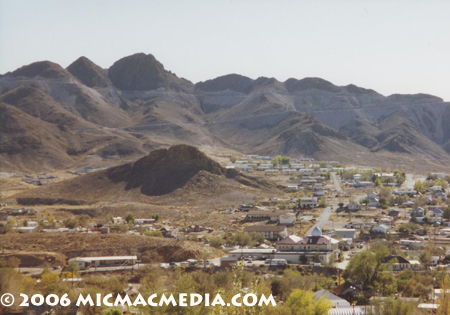
Photo #1: Town of Tonopah perched at 5,427 feet above sea level.
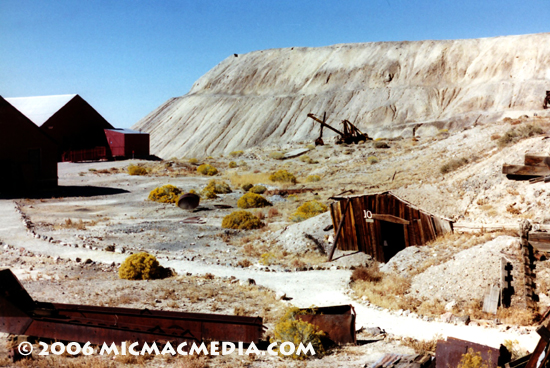
Photo #2: A tour through the Tonopah Historic Mining Camp is a must see. Note the scale of the steam
engine and the mountain of waste rock (tailings) behind.
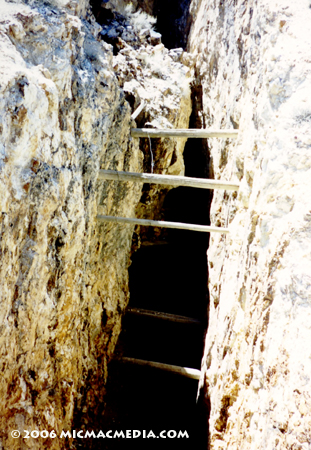
Photo #3: This was a rich vein, or "stope" that breached the surface. Miners dug it out and used timbers to prevent collapse while they
extracted the silver ore.
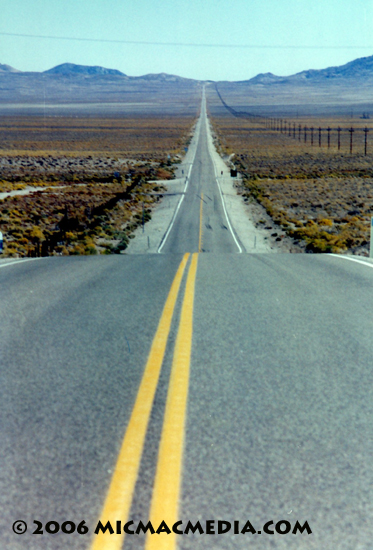
Photo #4: Highway 6, the road to Tonopah. Designed for cruise control.
|